








Skip links

Coin Shop Redesign

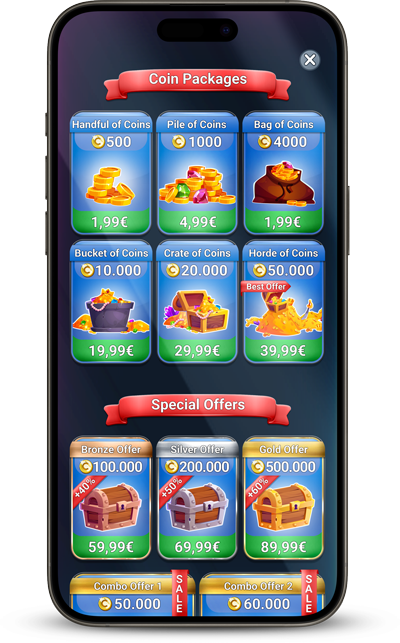
A redesigned mobile-first shop, so every option is easy to see and faster to buy.

✦ UX Design / UI Design
✦ In-App Purchases
✦ @Azerion

Project Brief

A New Coin Shop for the Social Game "Smeet"

Smeet's Coin Shop was the gateway to everything players wanted — but it was letting them down: Poorly adapted for mobile, visually outdated and with no clear hierarchy. The challenge was turning this overlooked utility into a smooth, intuitive experience players actually enjoy using.

Details

Platform

Mobile, Desktop

Team Size

Sole Ownership

Focus

Art Direction, User Research, Competitive Analysis, UI/UX Design, Visual Design

TLDR

As part of Smeet's overall UI revamp, I redesigned the Coin Shop end-to-end — from UX research and journey restructuring to final UI execution. The focus was on creating a frictionless, trustworthy purchase experience: clear pricing, personalized bundle offers for different player types, and reusable UI components for long-term scalability. The core challenge was balancing monetization goals with player trust — making spending feel rewarding rather than coercive.

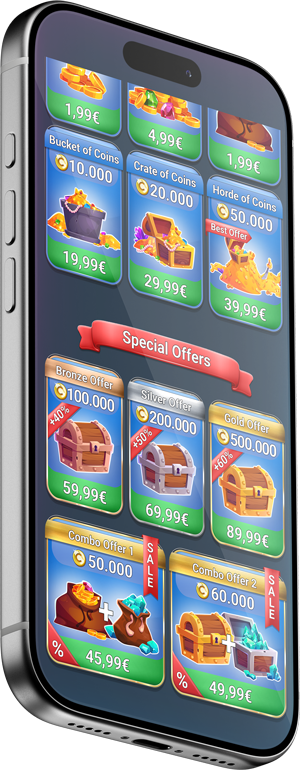
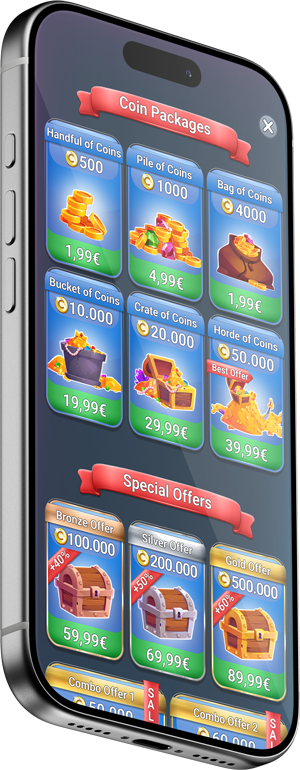
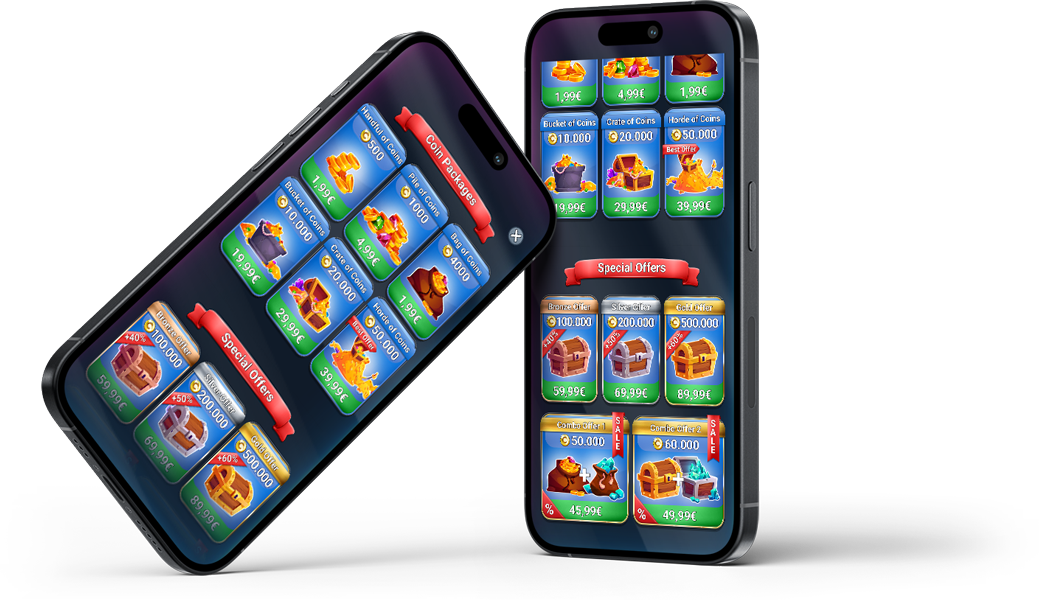
The Final Design

Understanding the Player

Empathize

01

I analyzed user behavior and competitors and accompanied players throughout their experience to understand how they interact with the shop and what drives or blocks purchase decisions. This was supported by a combination of qualitative and quantitative research, with surveys proving particularly insightful.

01   ✦   EMPATHIZE

The Original

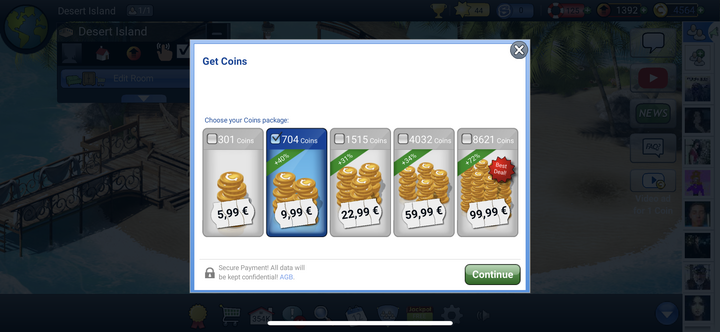
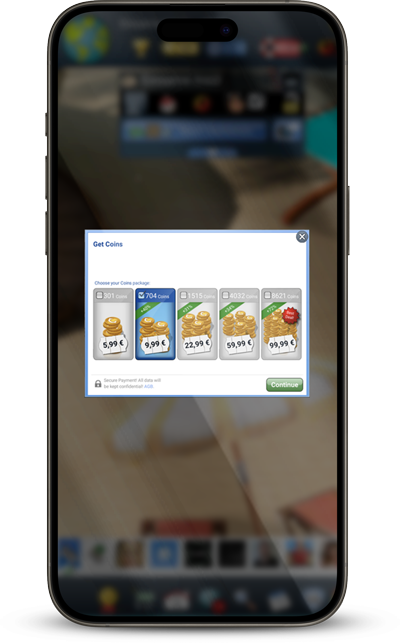
The original Coin Shop felt outdated and not optimized for mobile, with small elements and limited information. Multiple payment providers and currencies reduced clarity, while discounts were not transparent and the experience lacked personalization, making it confusing and unengaging.

Coin value is completely opaque

The vast majority of respondents had no idea what a coin unit was actually worth. Nobody could tell if 500 coins was "a lot" or "a little" in context, due to coin inflation and too many in-game currencies to begin with.

Trust deficit at first purchase

First-time buyers were dominated by confustion.
"Will my purchase actually arrive?"
"This looks really untrustworthy?"
"What can I even buy with this amount?"

No sense of urgency or relevance

The shop felt like a static inventory catalogue. No personalized offers, nothing that made the visit feel timely or relevant to the current session.

Social stigma around paying

Several players avoided purchases because they didn't see themselves as "someone who pays." Spending real money had a community stigma — seen as "cheating" progression.

01 Monetization & Pricing

Competitor analysis and a deep dive into monetization models and pricing psychology rounded out the research phase — identifying

Competitor analysis and a deep dive into monetization models and pricing psychology rounded out the research phase — identifying

which price points and discount structures tend to drive the most engagement, and what ethical boundaries matter to players.

01   ✦   Empathize

The Personas

The Invested Player

Daily active · Occasional spender

Goals

Accelerate progress without feeling bought
Find the objectively best deal available
Status items, exclusivity, visible edge Personalized offers that respect her history

Frustrations

Irrelevant offers shown regardless of level

The Casual Visitor

3–4× / week · Never purchased

Goals

Enjoys the game as-is without spending
Would pay if the value was crystal clear
Needs social proof or a trusted nudge

Frustrations

Has no idea what coins translate to
Shop feels like "not for me"

The New User

First Time · Never purchased

Goals

Wants to get to know the game
Would pay if the value was crystal clear
Needs social proof or a trusted nudge

Frustrations

Is confused by the sparse coin shop selection
Does not know how to use coins

Framing the problem

Define

02

The research pointed to a clear gap: the shop lacked clarity, felt generic, and offered no real sense of value. I defined the design brief around trust, transparency, and a more personalized experience.

01   ✦   DEFINE

The Main Pain Points

The existing shop suffered from a cluttered layout, unclear pricing, a one-size-fits-all structure, and legacy tech constraints that together hurt user trust, engagement, and conversions.

The Personalization


A one-size-fits-all bundle structure with generic offers failed to address individual player needs.

Outdated Design


The shop’s outdated visuals, poor mobile optimization, and small, inconsistent UI elements created an unengaging experience.
 

Interrupted Flow


The purchasing experience felt inconsistent due to lots of payment providers and payment methods. Too little system feedback interrupted the user flow.

Low Value Perception


Due to unclear communication of value, players lost trust and motivation at the point of purchase, resulting in a confusing and disengaging experience.

Information Clarity


Unclear pricing, multiple payment providers, and non-transparent discounts made it difficult to understand costs and value, while limited and inconsistent information made offers harder to evaluate.

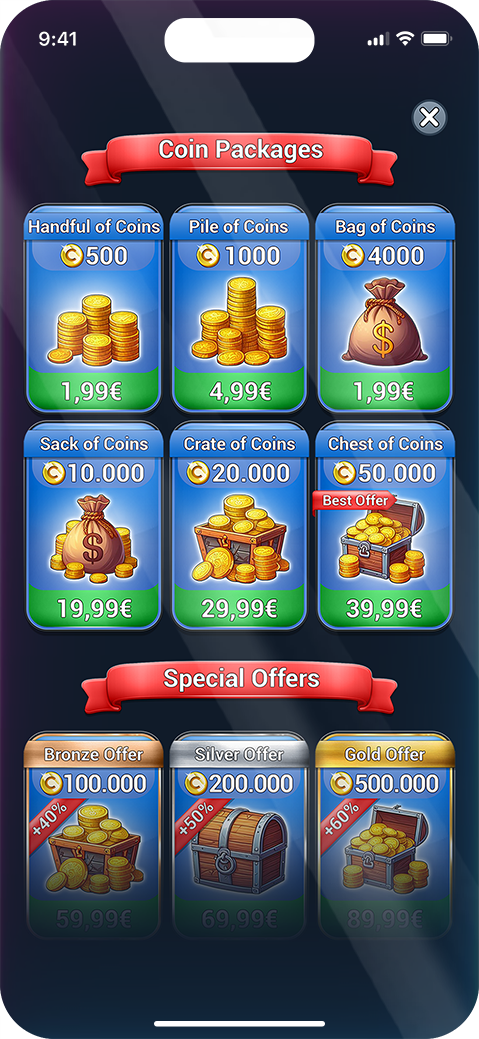
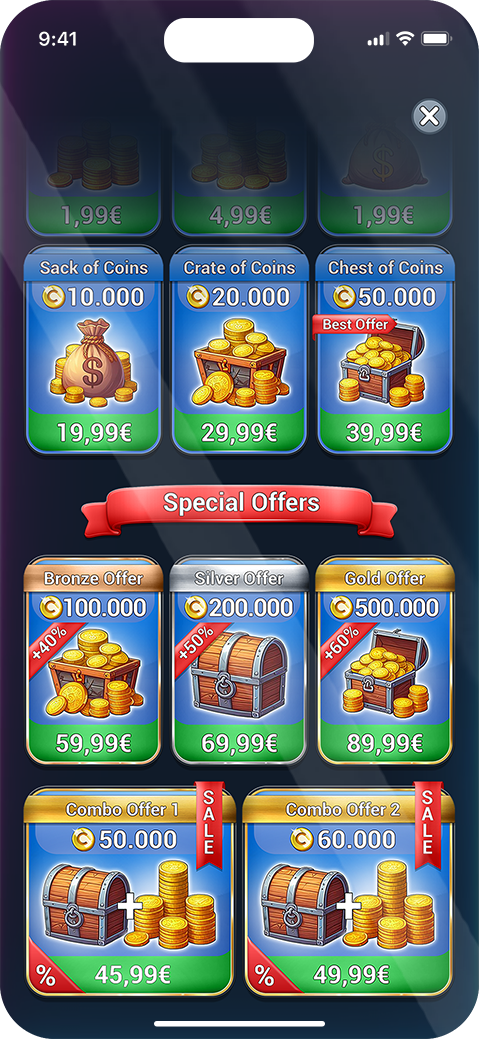
01 Deeper Than Visuals

The existing shop went beyond a visual issue. Inconsistent, tiny visuals, unclear information and a one-size-fits-all layout already left players confused.

The existing shop went beyond a visual issue. Inconsistent, tiny visuals, unclear information and a one-size-fits-all layout already left players confused.

But on top of that, technical constraints imposed by the game engine and payment providers disrupted the flow added an extra layer of complexity.
<sup style="font-size: 14px;">01</sup> 

Deeper Than Visuals

01 Deeper Than Visuals

The existing shop went beyond a visual issue. Inconsistent, tiny visuals, unclear information and a one-size-fits-all layout already left players confused. But on top of that, technical constraints imposed by the game engine and payment providers disrupted the flow added an extra layer of complexity.

Exploring Possibilities

Ideate

03

I explored different information architectures, bundle structures, and segmentation approaches to find a flow that worked for different player types — balancing UX goals with monetization requirements.

01 Value


For value communication and pricing, we explored concepts such as transparent bundle breakdowns, clearly labeled best-value offers, and personalized bundles based on player behavior.

For value communication and pricing, we explored concepts such as transparent bundle breakdowns, clearly labeled best-value offers, and personalized bundles based on player behavior.

02 Visuals

To increase visual impact, we explored ideas concerning more prominent visuals, renewed illustrations and reward previews.

03 Flow

In terms of purchase experience, we explored a streamlined checkout flow, and consistent offer layouts to make comparisons easier.

03   ✦   Ideate

The Most Promising Ideas

Visual Freshness

Visual Freshness

A modern visual identity transforms the entire feel of the shop. Finally, the style will convey a sense of a professional product.

Personalized Bundles

Personalized Bundles

New bundle concepts were developed with pricing strategies informed by earlier research, aiming to deliver clear value while supporting monetization goals.

Reworked Flow

Reworked Flow

With the problem framed, I explored different approaches to restructuring the purchase flow and bundle architecture — rethinking how offers are presented across different player segments.
Making It Tangible

Prototype

04

UX concepts were translated into wireframes and interactive prototypes, covering the full purchase flow and tested against technical constraints from the game engine and payment providers.

01 Journey Mapping

I translated UX concepts into wireframes and interactive prototypes. 

Selected ideas were translated into low-fidelity wireframes to make them tangible and testable.

I translated UX concepts into wireframes and interactive prototypes. Selected ideas were translated into low-fidelity wireframes to make them tangible and testable.

The focus was on visualizing shop structures, bundle layouts, and purchase flows while keeping the designs simple and iterative.

02 Killing Darlings


Some third-party payment providers caused the purchase flow to be overly complex, with too many steps to complete a purchase and unclear transitions between screens.

Some third-party payment providers caused the purchase flow to be overly complex, with too many steps to complete a purchase and unclear transitions between screens.

Given the technical constraints of an outdated game engine, in this phase a lot of great concepts had to be buried.

<sup style="font-size: 14px;">01</sup> 

Journey Mapping

01 Journey Mapping

I translated UX concepts into wireframes and interactive prototypes. Selected ideas were translated into low-fidelity wireframes to make them tangible and testable. The focus was on visualizing shop structures, bundle layouts, and purchase flows while keeping the designs simple and iterative.

<sup style="font-size: 14px;">02</sup> 


Killing Darlings

02 Killing Darlings

Some third-party payment providers caused the purchase flow to be overly complex, with too many steps to complete a purchase and unclear transitions between screens. Given the technical constraints of an outdated game engine, in this phase a lot of great concepts had to be buried.

Testing with Users

Test

05

Prototypes were tested for usability, pricing clarity, and perceived value. The feedback fed directly into design iterations until the interface was intuitive, and the component system was ready to scale.

01 Baby Steps

Player feedback and usability testing drove continuous refinement of the shop's layout and interaction flow.

Player feedback and usability testing drove continuous refinement of the shop's layout and interaction flow.

Pain points around pricing clarity and navigation were addressed through targeted iterations, each bringing the experience closer to something that felt intuitive and trustworthy.

02 Scalability

The final UI was built with reusable components to ensure consistency across the shop and support future scalability.

The final UI was built with reusable components to ensure consistency across the shop and support future scalability.

This made it easy to introduce new bundles or seasonal offers without redesigning from scratch.

<sup style="font-size: 14px;">01</sup> 

Baby Steps

01 Baby Steps

Player feedback and usability testing drove continuous refinement of the shop's layout and interaction flow. Pain points around pricing clarity and navigation were addressed through targeted iterations, each bringing the experience closer to something that felt intuitive and trustworthy.

<sup style="font-size: 14px;">02</sup> 


Scalability

02 Scalability

The final UI was built with reusable components to ensure consistency across the shop and support future scalability. This made it easy to introduce new bundles or seasonal offers without redesigning from scratch.

04   ✦   Test
Recommended Future Steps

Next Iterations

Deepened A/B Testing of Bundles

The new bundles and pricing strategies were developed based on research — a logical next step would be to test different bundle sizes, discount displays, or "Best Value" highlights against each other to optimize based on real data.

Non-Monetary Earning Mechanics

One of the most interesting takeaways is that the shop needs more direct ways to earn coins. A next iteration could fully integrate these already existing in-game systems into the shop flow, so the shop is perceived as a hub rather than just a purchase point.

Seasonal & Event-Based Shop States

Tying limited bundles and visual shop themes to in-game events or seasons (holidays, challenge seasons) could create urgency and a reason to return, while also making the shop feel alive and dynamic over time.

What We Achieved

Impact & Learnings

06

Progress is rarely linear and often shaped by small adjustments along the way. Different perspectives can lead to more balanced and thoughtful decisions. The new coin shop design improved perceived value, clarity, and user satisfaction through tailored offers and enhanced presentation, resulting in more positive player feedback.

✦   Impact & Learnings
Final Notes

Key Takeaways

Ethical Design
Monetization Balance

Monetization Balance

Ensuring a balance between monetization goals and the user experience can be tricky. In-game purchases are supposed to be enticing, but not coercive. The project started out as a UI adjustment, but soon raised questions about the current flow/user journey concerning acquiring coins. We needed to provide players with more direct non-monetary ways to earn rewards, making the shop feel optional but rewarding.


✦   Impact & Learnings
Final Notes

The Impact

Clear Information
Gaining Back Trust

Gaining Back Trust

Clear benefit and currency displays built trust and credibility, using ethical monetization that made players feel valued. This fostered long-term loyalty and a positive player-game relationship.

Higher Satisfaction
Creating Variety

Creating Variety

Having a greater variety of individual offers tailored to different types of users ensured that every player could find a suitable suggestion, while also leading to improved feedback for the new coin shop. These variations proved pivotal in increasing overall player satisfaction.

✦   Contact Me

Have a project in mind?

Looking for collaboration? Send an email to helloooo@vhoffmann.design for inquiries and projects or fill out the form.

Send a Message


    This website uses cookies to improve your web experience.